
-
Call: +91 9028005102
-
Email: enquiry@medihse.in
What Is a HAZOP Study? A Practical Guide to Process Safety
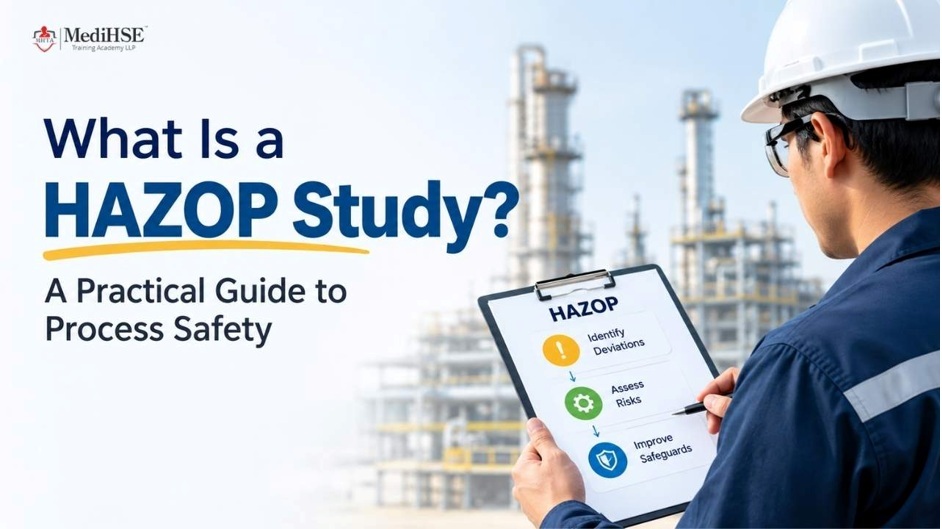
In industries handling hazardous chemicals, flammable materials, high pressures or complex processes, identifying hazards before an incident occurs is critical. A HAZOP study (Hazard and Operability Study) is a structured technique used to identify potential deviations from intended process conditions and evaluate their possible consequences. Understanding HAZOP is an important part of industrial HSE training and professional safety practices.
What Is a HAZOP Study?
HAZOP is a systematic and multidisciplinary risk assessment methodology originally developed for analysing process plants.
It examines a process using specific guide words to identify deviations from the design intent.
Common HAZOP guide words include:
No – complete absence of the intended condition
More – quantitative increase
Less – quantitative decrease
Reverse – opposite of the intended flow or action
Other Than – a different condition or material occurs
For example, while analysing a pipeline, the guide word “No” + “Flow” creates the deviation “No Flow.” The team then investigates possible causes,
consequences, existing safeguards and recommendations.
How Is a HAZOP Study Conducted?
A typical HAZOP involves a trained team consisting of process engineers, operations personnel, instrumentation specialists, maintenance professionals and HSE experts.
The process generally includes:
1. Define the design intent:
The team establishes what the process, equipment or node is supposed to achieve.
2. Identify deviations:
Guide words are systematically applied to process parameters such as flow, pressure, temperature, level and composition.
3. Determine causes:
The team identifies potential reasons for each deviation, such as equipment failure, incorrect operation, control-system malfunction or human error.
4. Evaluate consequences:
Potential outcomes such as equipment damage, fire, toxic release, production loss or personnel exposure are assessed.
5. Review safeguards:
Existing preventive and mitigative controls—alarms, interlocks, relief systems, procedures and emergency systems—are examined.
6. Develop recommendations:
Where existing controls are inadequate, the team proposes additional safeguards or design and procedural improvements.
Why Is HAZOP Important for Process Safety?
HAZOP helps organisations move from reactive accident response to proactive risk management. It can reveal interactions and process deviations that may not be obvious during routine operations. It is particularly valuable during plant design, modifications, commissioning and major process changes. Professionals who understand HAZOP methodology can make better risk-informed decisions. This is why HAZOP principles are often covered in advanced industrial HSE training and specialised safety training courses in India.
Build Stronger Process Safety Knowledge with MediHSE
A well-executed HAZOP study is more than a compliance exercise—it is a systematic approach to understanding process risks and strengthening safeguards.
Organisations can benefit from competent professionals who have practical knowledge of hazard identification, risk assessment and control measures.
Quality industrial HSE training and relevant safety training courses in India can help develop
these essential process-safety capabilities.
Also read: Why Workplace Safety Is Essential for Every Industry